
Close-up of a healthcare worker wearing protective glasses

Sound Decisions in Healthcare Design

Medical care depends on trust—especially the trust that conversations will remain confidential. Yet healthcare environments often undermine that expectation, compromising care in the process. Download our latest white paper to learn how acoustic privacy affects patient outcomes, staff retention, and HIPAA compliance.

Part I

Noise and wellbeing

Patient and staff areas often exceed the maximum decibel levels recommended by the Facility Guidelines Institute and the World Health Organization. In Part 1, we examine which healthcare spaces are the loudest and how excessive noise affects recovery times, stress levels, and patient-provider communication.

  • Healthcare
  • Privacy
  • Wellbeing
Doctor holding his head while healthcare workers move in the background
Clinician resting against a wall in a quiet healthcare space

Part II

Cost, flexibility, and privacy

As hospitals adopt open-plan layouts and multipurpose spaces, conversations increasingly travel beyond walls and down hallways. In Part 2, we look at why healthcare facilities prioritize space efficiency over acoustic and visual privacy—and how those decisions affect HIPAA compliance and the patient experience.

  • Architecture
  • Flexibility
  • Space planning

Part III

Silencing the noise

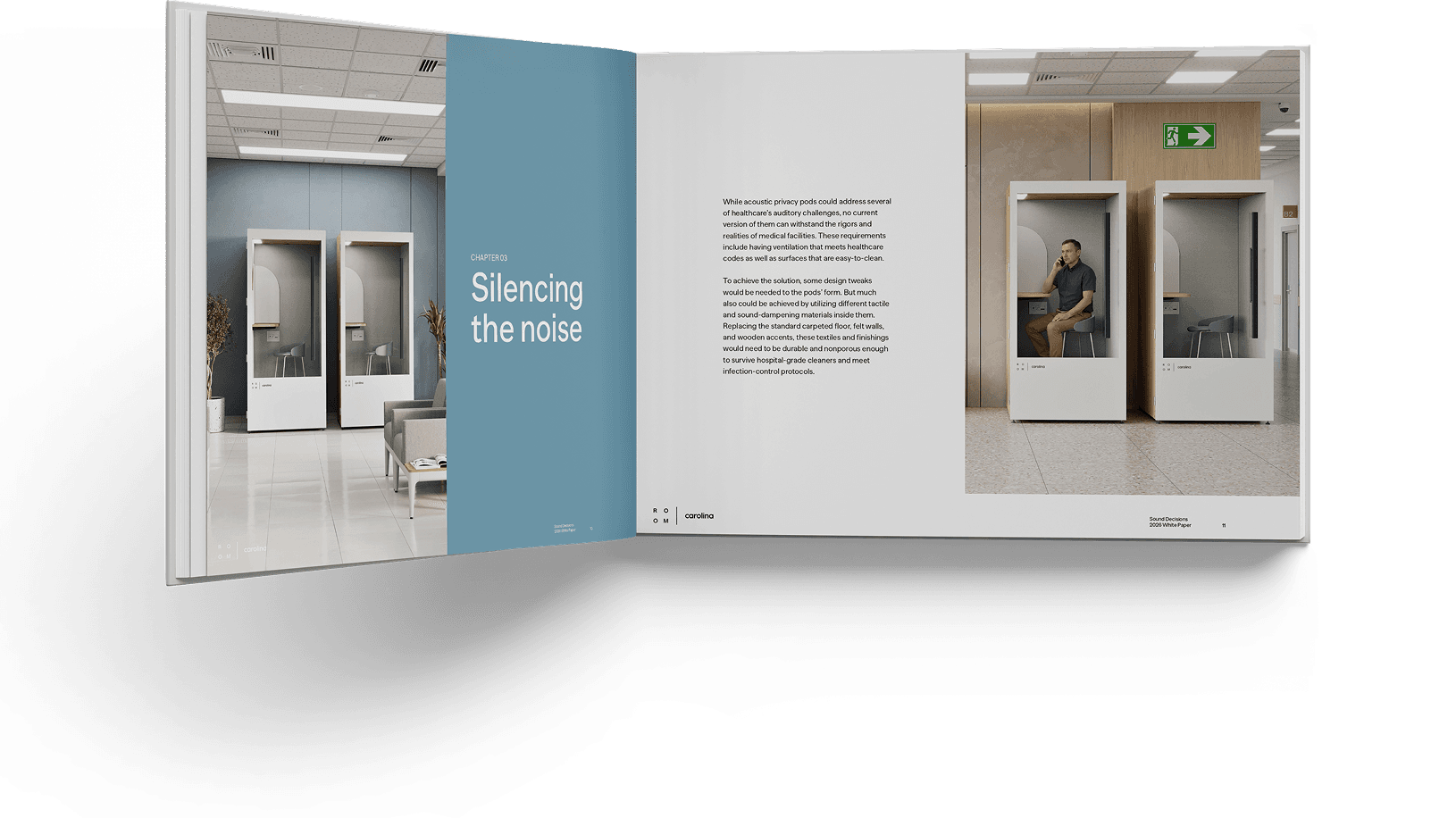
Could modified acoustic pods give patients and caregivers greater speech privacy? In Part 3, we explore how acoustic pods could function in healthcare settings, including potential use cases and design considerations.

  • Acoustics
  • Modular
  • Design
Busy hospital corridor with blurred medical staff in motion

NEW WHITE PAPER

Sound Decisions

In healthcare, acoustic privacy is not optional—it is essential for patient trust, effective treatment, and legal compliance. Learn how hospitals and clinics can create more private, supporting care environments.

Open Sound Decisions white paper magazine preview